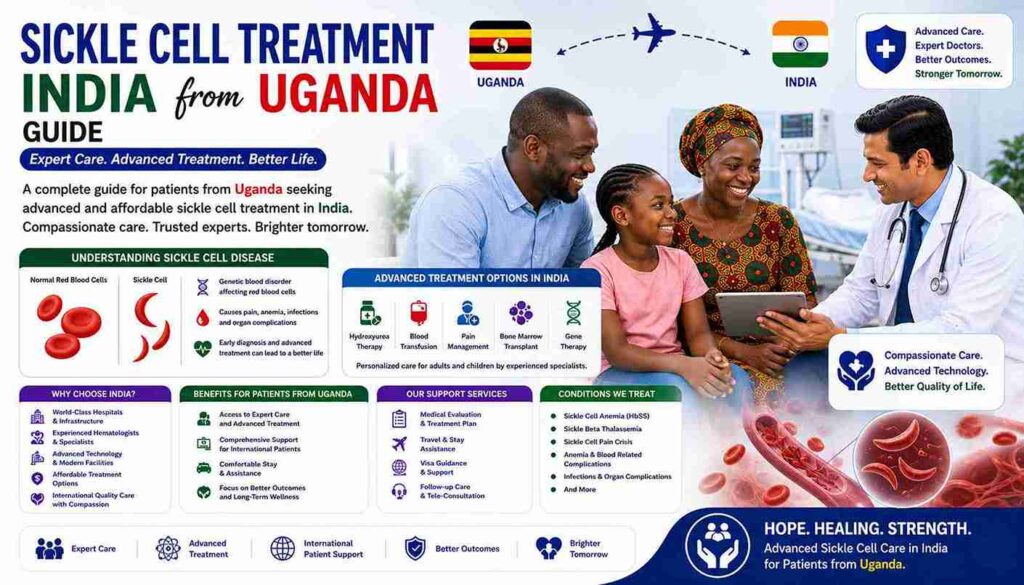
Sickle Cell Treatment India from Uganda: Complete Patient Guide
For many Ugandan families, sickle cell disease is not just a medical condition. It affects school, work, family finances, and daily peace of mind. Parents often search for sickle cell treatment India from Uganda when local care is not enough, complications are increasing, or doctors suggest curative treatment such as bone marrow transplant.
Sickle cell disease is a serious inherited blood disorder. The World Health Organization says sub-Saharan Africa carries nearly 80% of the global burden, and Uganda is among the affected countries. Research also reports that Uganda has a high sickle cell burden, with thousands of babies born with the disease each year.
India has become a preferred destination for many international patients because it offers experienced hematologists, pediatric hemato-oncologists, bone marrow transplant units, advanced diagnostics, and comparatively affordable care.
MediHelp Global helps patients from Uganda and other countries compare hospitals, collect medical opinions, understand estimated costs, arrange medical visa documents, plan travel, and coordinate care after arrival in India.
Why Ugandan Families Choose India for Sickle Cell Treatment
Families from Kampala, Jinja, Mbarara, Gulu, Mbale, Entebbe, and other parts of Uganda often consider India because sickle cell care may require long-term planning, expert monitoring, and sometimes transplant evaluation.
India is especially considered when a patient has:
Frequent pain crises
Repeated blood transfusions
Stroke risk or previous stroke
Severe anemia
Acute chest syndrome
Poor growth in children
Organ complications
A matched sibling donor
Need for bone marrow transplant evaluation
The goal is not always transplant. Some patients need better disease control, infection prevention, transfusion planning, or specialist review. Others may be candidates for curative treatment.
What Is Sickle Cell Disease?
Sickle cell disease changes the shape of red blood cells. Instead of being soft and round, the cells can become hard, sticky, and crescent-shaped. These cells may block blood flow, causing pain, anemia, infections, stroke, chest problems, and organ damage.
It is inherited. A child may develop sickle cell disease when both parents pass on the sickle cell gene. That is why family testing, genetic counselling, and sibling donor matching are very important.
Sickle Cell Treatment Options in India
1. Medical management
Many patients need strong ongoing care before any curative decision. This may include:
Hydroxyurea therapy
Pain crisis management
Vaccination planning
Infection prevention
Blood transfusion support
Iron overload monitoring
Stroke screening in children
Organ function testing
This approach helps reduce complications and improves quality of life, but it does not usually cure sickle cell disease.
2. Bone marrow transplant
Bone marrow transplant, also called stem cell transplant, is the most established curative option for selected sickle cell patients. In this treatment, unhealthy blood-forming cells are replaced with healthy stem cells from a donor.
The best donor is usually a fully matched brother or sister. Some hospitals may also evaluate haploidentical donors, such as a parent, depending on the patient’s condition and doctor’s advice.
Before transplant, doctors usually check:
HLA matching
Age and weight
Infection history
Organ function
Previous transfusions
Stroke or lung history
Donor fitness
Family readiness for long stay
MediHelp Global can help Ugandan families share reports with Indian BMT specialists and receive a case-based opinion before travel.
3. Gene therapy
Gene therapy is an important new area in sickle cell treatment. However, for many African families, it may still be difficult because of high cost, limited access, and complex logistics. For now, bone marrow transplant remains the more practical curative route for many eligible international patients.
Sickle Cell Anemia Treatment Cost in India
The sickle cell anemia treatment cost in India depends on the treatment type, hospital, donor match, patient condition, room category, infections, ICU need, and length of stay.
General market estimates for bone marrow transplant for sickle cell disease in India often range from about USD 18,000 to USD 45,000, while some sources quote higher ranges depending on transplant type and complexity.
A practical cost estimate may include:
Cost factor
Why it matters
HLA matching
Confirms donor suitability
Pre-transplant tests
Checks heart, liver, kidney, lungs, infections
Hospital stay
BMT requires protected care
Medicines
Immunosuppressants and infection prevention
Donor type
Matched sibling may cost less than complex donor options
Complications
Infection or ICU care can increase cost
Stay in India
Families may need weeks or months near hospital
Families should avoid fixed-cost promises without report review. A responsible estimate must be based on medical documents.
Step-by-Step Process with MediHelp Global
Step 1: Share medical records
Send the patient’s diagnosis report, CBC, Hb electrophoresis or HPLC report, transfusion history, current medicines, infection history, and any organ test reports.
Step 2: Share family donor details
If the patient has siblings, parents should share sibling age and health details. Doctors may advise HLA testing.
Step 3: Get opinion from Indian specialists
MediHelp Global helps connect the case with suitable hematologists, pediatric hemato-oncologists, or bone marrow transplant doctors in India. MediHelp Global also lists doctors who handle sickle cell anemia care.
Step 4: Compare hospital plan and cost
The family receives a treatment recommendation, expected stay, estimated cost, and next steps.
Step 5: Arrange medical visa documents
After hospital confirmation, the family can prepare the medical visa application and attendant visa documents.
Step 6: Travel and start evaluation in India
Final treatment begins only after physical evaluation, repeat testing, and doctor approval.
Step 7: Continue follow-up after returning to Uganda
Post-treatment follow-up is important. MediHelp Global helps coordinate communication with the treating team after the patient returns home.
Documents Needed from Uganda
Prepare these before requesting a hospital opinion:
Passport copy
Patient photos
Diagnosis report
Hb electrophoresis or HPLC report
CBC and blood group
Transfusion history
Current medication list
Previous admission records
Infection history
Sibling details for donor matching
Any HLA reports, if already done
How to Choose the Right Hospital in India
Do not choose only by the lowest cost. For sickle cell disease treatment in India, look for:
Experienced hematologist or pediatric BMT specialist
Dedicated bone marrow transplant unit
Infection-control protocols
ICU backup
Blood bank support
Transparent estimate
International patient support
Follow-up coordination
Clear explanation of risks and benefits
Competitors often focus heavily on generic African children or broad cost claims. This page is stronger because it speaks directly to Uganda families, explains donor matching, highlights realistic cost variables, and gives a clear MediHelp Global process.
FAQ Section
1. Is sickle cell treatment in India available for patients from Uganda?
Yes. Ugandan patients can travel to India for medical management, specialist review, transfusion planning, and bone marrow transplant evaluation.
2. Can sickle cell disease be cured in India?
Selected patients may be cured through bone marrow transplant if they are medically fit and have a suitable donor. The doctor must evaluate each case carefully.
3. What is the sickle cell anemia treatment cost in India?
Bone marrow transplant estimates commonly range from about USD 18,000 to USD 45,000, depending on donor type, hospital, patient condition, and complications.
4. Does every sickle cell patient need a transplant?
No. Many patients are managed with medicines, transfusion support, vaccination, monitoring, and complication prevention.
5. How long does a patient need to stay in India?
For transplant, families may need to stay for several weeks or months. For consultation or medical management, the stay may be shorter.