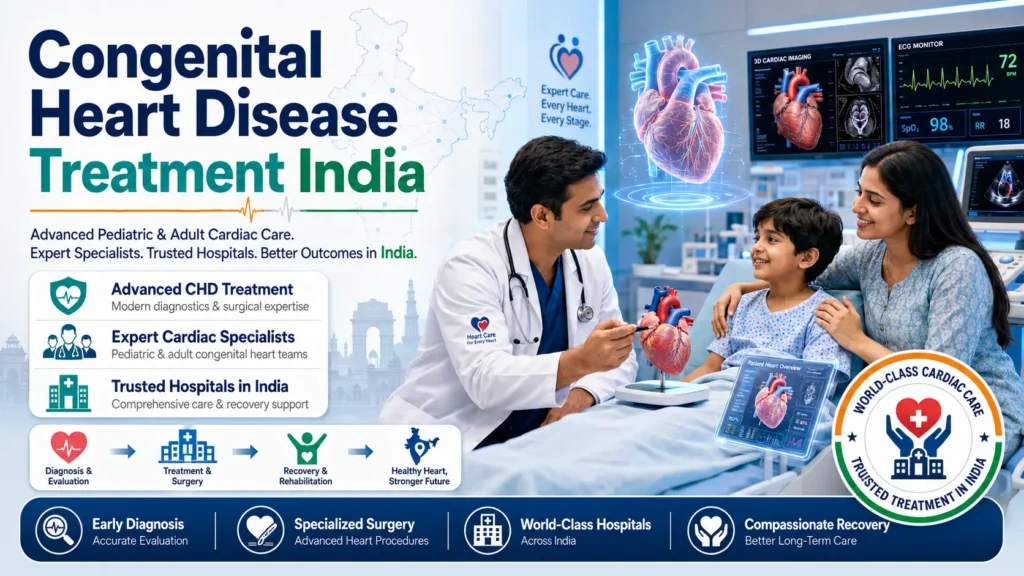
Congenital heart disease (CHD) is one of the most common birth-related heart conditions affecting infants and children worldwide. Many families search for congenital heart disease treatment India because the country offers advanced cardiac care, experienced pediatric cardiologists, and affordable treatment options compared to Western countries.
India has become a global hub for CHD treatment due to its combination of medical expertise and cost-effective healthcare infrastructure.
What is Congenital Heart Disease?
Congenital heart disease refers to structural or functional abnormalities in the heart that are present at birth. These defects affect how blood flows through the heart and can impact oxygen supply to the body.
Pathophysiology (Simple Explanation)
CHD occurs when the heart does not develop properly during fetal growth, leading to:
Abnormal blood flow patterns (shunting)
Mixing of oxygen-rich and oxygen-poor blood
Increased workload on heart chambers
If untreated, these changes may lead to heart failure, pulmonary hypertension, or developmental delay.
Types of Congenital Heart Disease
Acyanotic Congenital Heart Disease
These defects usually do not cause low oxygen levels initially.
Common examples:
Ventricular Septal Defect (VSD)
Atrial Septal Defect (ASD)
Patent Ductus Arteriosus (PDA)
Coarctation of Aorta
👉 These conditions often lead to increased blood flow to the lungs.
Cyanotic Congenital Heart Disease
These conditions reduce oxygen levels in blood, causing bluish skin discoloration.
Common types include:
Tetralogy of Fallot
Transposition of Great Arteries (TGA)
Tricuspid Atresia
Total Anomalous Pulmonary Venous Return (TAPVR)
Hypoplastic Left Heart Syndrome
👉 These are more complex and often require early surgical intervention.
Causes and Risk Factors
Although the exact cause is often unknown, key risk factors include:
Genetic abnormalities and family history
Maternal diabetes
Viral infections (like rubella during pregnancy)
Alcohol or smoking during pregnancy
Certain medications affecting fetal development
Symptoms and Early Warning Signs
In infants:
Fast breathing
Poor feeding
Bluish lips or skin
Poor weight gain
Frequent lung infections
In older children:
Fatigue
Chest pain
Dizziness or fainting
Reduced exercise tolerance
Irregular heartbeat
Diagnosis and Role of Radiology
Accurate diagnosis is critical in CHD management.
Key Diagnostic Tools:
Key Diagnostic Tools:
First-line test for evaluating heart structure and function
Fetal Echocardiography
Detects heart defects before birth.
Chest X-ray & Radiology
Used to assess heart size and lung blood flow changes.
Advanced Imaging
Cardiac MRI
CT scan
Cardiac Catheterization
Used for both diagnosis and minimally invasive treatment.
Congenital Heart Disease Treatment in India
India offers a complete spectrum of CHD treatment depending on severity.
Medical Management
Used for mild cases or stabilization:
Diuretics
Beta-blockers
Oxygen therapy
Surgical Treatment
1. Open-Heart Surgery
Used for complex defects like:
VSD
Tetralogy of Fallot
Valve abnormalities
2. Minimally Invasive Surgery
Faster recovery
Less trauma
Catheter-Based Procedures
Used for:
ASD closure
PDA closure
Balloon valvuloplasty
👉 These are less invasive and highly preferred in modern cardiology.
Recovery and Life Expectancy
Recovery Timeline:
ICU stay: 2–5 days
Hospital stay: 5–10 days
Full recovery: 4–8 weeks
Life Expectancy:
With timely treatment in India:
Many patients live normal, healthy lives
Early surgery significantly improves outcomes
Delayed treatment, however, can lead to complications.
Congenital Heart Disease ICD 10 Importance
In clinical documentation, CHD is classified under:
ICD-10: Q20–Q28 (Congenital malformations of heart)
This classification helps in:
Medical billing
Insurance processing
Clinical research tracking
Why Choose India for CHD Treatment?
India is a leading destination for congenital heart disease treatment India because:
Highly experienced pediatric cardiac surgeons
Advanced ICU and surgical infrastructure
Lower treatment cost vs USA/UK
Short waiting times
High success rates in pediatric surgeries
Expert Pediatric Cardiology Support in India
India also offers advanced training programs such as:
Pediatric cardiology fellowship
Specialized CHD surgical training programs
This ensures continuous improvement in treatment quality and outcomes.