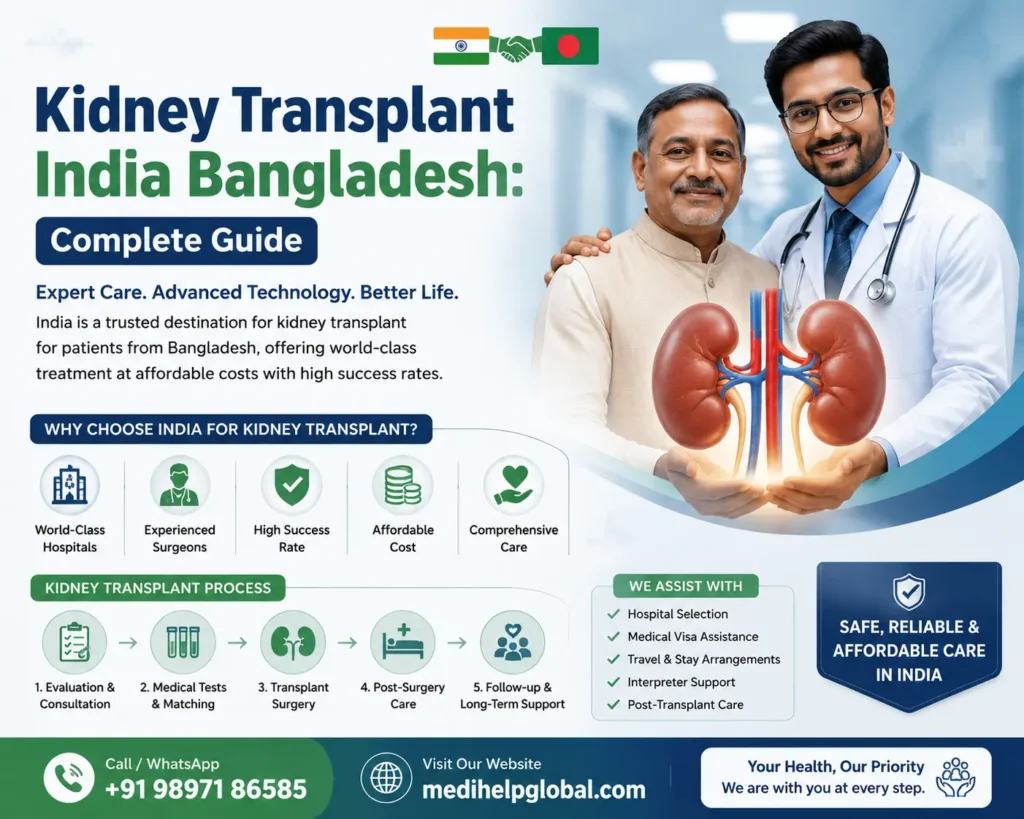
Kidney Transplant India Bangladesh: Cost, Best Hospitals, Donor Rules & Patient Support
For families searching for kidney transplant India Bangladesh, finding the right treatment destination is one of the most important decisions during end-stage kidney disease.
Kidney failure can affect every part of life. When dialysis becomes difficult or kidney function declines significantly, a kidney transplant may provide a better quality of life and long-term health improvement for suitable patients.
Many patients from Bangladesh consider India because it offers a combination of:
Experienced kidney transplant surgeons
Advanced transplant hospitals
Modern diagnostic facilities
Affordable treatment compared with Western countries
Short travel distance from Bangladesh
Bengali-friendly healthcare environments in several cities
India has developed a strong organ transplant ecosystem with dedicated teams involving nephrologists, transplant surgeons, urologists, anesthetists, critical care specialists, and rehabilitation experts.
At MediHelp Global, we support Bangladeshi patients throughout their medical journey by helping with:
Hospital selection
Kidney transplant cost estimation
Doctor consultation coordination
Donor documentation guidance
Medical visa assistance
Travel arrangements
Accommodation support
Follow-up coordination after returning to Bangladesh
Every transplant case is different. The final treatment plan depends on the patient’s health condition, donor availability, medical reports, and evaluation by a qualified transplant team.
Why Bangladeshi Patients Choose India for Kidney Transplant
India has become one of the preferred destinations for kidney transplantation among international patients, including those from Bangladesh.
Several factors make India an attractive option.
Experienced Kidney Transplant Specialists
Successful kidney transplantation requires teamwork and experience.
Indian transplant hospitals usually have specialists including:
Nephrologists
Kidney transplant surgeons
Urologists
Immunologists
ICU specialists
Infection control teams
Experienced teams help manage every stage, from donor evaluation to long-term post-transplant monitoring.
Affordable Kidney Transplant Treatment
One of the biggest reasons Bangladeshi patients choose India is the comparatively lower treatment cost.
Compared with countries such as the USA, UK, and Singapore, kidney transplant treatment in India is often significantly more affordable while still providing advanced medical infrastructure.
The overall expense depends on:
Hospital category
City
Surgeon experience
Donor evaluation
ICU requirements
Medicines
Possible complications
Advanced Kidney Transplant Technology
Leading Indian hospitals use modern technologies and protocols such as:
HLA tissue matching
Crossmatch testing
Advanced imaging
Dedicated transplant ICUs
Infection prevention systems
Minimally invasive techniques in selected cases
Some hospitals also offer robotic-assisted procedures where clinically appropriate.
Convenient Travel From Bangladesh to India
Bangladesh patients benefit from easier access because India is geographically close.
Common advantages include:
Short flight duration
Multiple travel routes
Cultural familiarity
Similar food preferences
Availability of Bengali-speaking assistance in some locations
Popular treatment cities include:
Kolkata
Chennai
Delhi NCR
Hyderabad
Mumbai
Bengaluru
Kidney Transplant Cost in India for Bangladeshi Patients
Understanding the cost is one of the first concerns for international patients.
The kidney transplant cost in India depends on several medical and non-medical factors.
Average Kidney Transplant Cost in India
Treatment Component
Approximate Cost
Kidney transplant package
USD 13,000 – 18,000
Indian currency estimate
₹10 lakh – ₹15 lakh+
Bangladesh currency estimate
৳15 lakh – ৳22 lakh+
Pre-transplant evaluation
Depends on required tests
Post-transplant medicines
Additional monthly expense
These are approximate estimates. The final cost can vary after reviewing medical reports and transplant requirements.
Kidney Transplant Cost Comparison: India vs Other Countries
Country
Approximate Kidney Transplant Cost
India
USD 13,000 – 18,000
USA
USD 300,000+
UK
USD 60,000 – 75,000
Singapore
USD 50,000 – 65,000
India provides a cost-effective option for many international patients seeking kidney transplantation.
Factors That Affect Kidney Transplant Cost in India
The final treatment package depends on multiple factors.
Pre-Transplant Evaluation Cost
Before surgery, both patient and donor may require several tests.
These may include:
Blood tests
Kidney function tests
HLA typing
Tissue matching
Crossmatch testing
Infection screening
Imaging tests
Cardiac evaluation
Surgery and Hospital Expenses
The transplant package may include:
Transplant surgeon fees
Operation theatre charges
Hospital room
ICU monitoring
Nursing care
Medicines
Laboratory tests
Post-Transplant Expenses
After transplantation, patients require lifelong monitoring.
Possible expenses include:
Immunosuppressant medicines
Blood tests
Doctor consultations
Infection management
Emergency care if complications occur
Kidney Transplant Cost in Major Indian Cities
Costs may vary depending on hospital location.
City
Estimated Cost Range
Kolkata
USD 13,000–17,000
Chennai
USD 13,000–18,000
Delhi NCR
USD 14,000–20,000
Hyderabad
USD 13,000–18,000
Mumbai
USD 15,000–22,000
Patients should choose hospitals based on transplant expertise and safety standards, not only price.
Best Kidney Transplant Hospitals in India for Bangladeshi Patients
Choosing the right kidney transplant hospital is one of the most important decisions for patients traveling from Bangladesh.
The best hospital is not always the most expensive one. The right choice depends on:
Experience of the transplant team
Number of kidney transplants performed
Availability of transplant ICU
Infection control standards
Donor evaluation process
Cost transparency
International patient support
Follow-up options after returning to Bangladesh
Some leading kidney transplant hospitals in India include:
Kidney Donor Rules for Bangladeshi Patients in India
Kidney transplantation from a living donor is strictly regulated in India.
Foreign patients cannot simply arrange a donor after arriving in India. The donor-recipient relationship must meet Indian legal requirements.
For Bangladeshi patients, the donor is generally expected to be a close relative or a legally accepted donor according to Indian transplant regulations.
Common acceptable relationships may include:
Father
Mother
Brother
Sister
Son
Daughter
Spouse
The final approval depends on medical evaluation and authorization committee review.
Living Donor Evaluation Process
A donor must be medically fit and compatible with the recipient.
The evaluation usually includes:
Blood Group Compatibility
Doctors check whether donor and recipient blood groups are suitable.
HLA Tissue Matching
Human Leukocyte Antigen (HLA) testing helps evaluate immune compatibility between donor and recipient.
Better matching may reduce rejection risks.
Crossmatch Testing
Crossmatch tests check whether the recipient’s immune system may react against the donor kidney.
Donor Health Assessment
Doctors evaluate:
Kidney function
Blood pressure
Diabetes status
Infection screening
Overall physical fitness
A donor must voluntarily agree after understanding the risks and process.
Documents Required for Kidney Transplant From Bangladesh to India
International kidney transplant patients need proper documentation before starting treatment.
Patient Documents
Commonly required documents include:
Valid passport
Medical visa
Passport photographs
Kidney disease reports
Dialysis records
Doctor referral letter
Previous treatment history
Blood test reports
Donor Documents
The donor may require:
Passport
Passport photographs
National identity documents
Medical reports
Blood group report
HLA matching reports
Crossmatch reports
Fitness certificates
Relationship Proof Documents
Since donor relationship is an important legal requirement, documents may include:
Birth certificate
Marriage certificate
Family relationship certificate
Government-issued relationship proof
Embassy verification documents, if required
Authorization Committee Documents
Foreign donor cases may require:
Affidavits
Consent documents
Relationship verification
Financial documents
Personal appearance before the committee
Both donor and recipient may need to be physically present for legal procedures.
Step-by-Step Kidney Transplant Process for Bangladeshi Patients
A planned approach makes the transplant journey smoother.
Step 1: Share Medical Reports
The first step is a medical evaluation.
Patients can share:
Creatinine reports
eGFR reports
Dialysis history
Ultrasound reports
Kidney biopsy reports (if available)
Current medicines
Previous medical records
Doctors review these reports and suggest the next steps.
Step 2: Donor Screening and Matching
If a living donor is available, doctors evaluate:
Blood compatibility
HLA matching
Crossmatch results
Donor kidney health
Legal relationship documents
Step 3: Hospital Selection and Cost Planning
MediHelp Global helps patients compare suitable hospitals based on:
Transplant expertise
Location
Treatment cost
Doctor availability
International patient services
Patients receive a clearer understanding of expected expenses before traveling.
Step 4: Medical Visa Process
Bangladeshi patients require a medical visa for kidney transplant treatment in India.
Required documents usually include:
Passport
Medical reports
Indian hospital invitation letter
Doctor recommendation
Supporting financial documents
MediHelp Global assists patients with hospital coordination and visa documentation guidance.
Step 5: Travel to India
International patient support may include:
Airport pickup
Accommodation near hospital
Local transportation
Language assistance
Hospital admission coordination
Step 6: Kidney Transplant Surgery
Kidney transplantation usually involves two procedures:
Donor Surgery
The healthy kidney is removed from the donor using appropriate surgical techniques.
Recipient Surgery
The donor kidney is placed into the recipient’s body and connected to blood vessels and urinary pathways.
After surgery, the patient is monitored closely.
Recovery After Kidney Transplant
Recovery depends on:
Patient health
Kidney function
Infection risk
Response to medicines
During recovery, doctors monitor:
Urine output
Kidney function
Blood pressure
Infection signs
Medicine levels
Many patients remain under medical observation for several weeks after surgery.
How Long Should Bangladeshi Patients Stay in India After Kidney Transplant?
The required stay varies from patient to patient.
Many international patients may need to remain in India for several weeks after transplantation.
The duration depends on:
Stable kidney function
Medication adjustment
Doctor approval
Absence of complications
Patients should not plan their return travel without clearance from the transplant team.
Kidney Transplant Success Rate in India
Kidney transplant outcomes depend on multiple factors.
Important factors include:
Donor kidney quality
Patient age
Overall health
Diabetes and blood pressure control
Medicine compliance
Infection prevention
Regular follow-up
Experienced transplant centers often achieve strong outcomes, especially with living donor transplantation.
However, success cannot be guaranteed for every patient.
Maximum Life After Kidney Transplant
A kidney transplant is not just a surgery; it is a lifelong medical commitment.
Many patients continue living active lives for many years after transplantation.
Long-term kidney survival depends on:
Taking Medicines Regularly
Anti-rejection medicines must be taken exactly as prescribed.
Missing medicines can increase rejection risk.
Regular Medical Monitoring
Patients need:
Blood tests
Kidney function monitoring
Doctor consultations
Healthy Lifestyle
Patients are encouraged to maintain:
Balanced diet
Healthy weight
Controlled blood pressure
Controlled diabetes
Infection prevention habits
Medical Visa India for Bangladeshi Kidney Transplant Patients
Bangladeshi patients traveling to India for kidney transplantation need an appropriate medical visa.
The process usually requires:
Patient passport
Donor passport (if applicable)
Indian hospital invitation letter
Medical documents
Treatment recommendation
MediHelp Global supports patients by coordinating:
Hospital invitation letters
Treatment appointments
Medical travel planning
How MediHelp Global Helps Bangladeshi Kidney Transplant Patients
A kidney transplant journey involves medical, legal, and travel challenges.
MediHelp Global supports patients from Bangladesh through every stage.
Before Treatment
We assist with:
Medical report review
Hospital selection
Specialist consultation coordination
Treatment planning
During Transplant Planning
Support includes:
Cost estimation
Donor documentation guidance
Hospital communication
Medical visa assistance
During India Stay
Patients receive support with:
Airport pickup coordination
Accommodation assistance
Hospital admission
Local travel support
Communication assistance
After Returning to Bangladesh
Long-term follow-up is important.
Support may include:
Follow-up appointment coordination
Medical report sharing
Teleconsultation arrangements
Continued communication with hospital teams
Frequently Asked Questions About Kidney Transplant India Bangladesh
1. How much does kidney transplant cost in India for Bangladeshi patients?
The kidney transplant cost in India for Bangladeshi patients is usually around USD 13,000 to USD 18,000. The final amount depends on hospital, donor evaluation, medicines, ICU stay, and complications.
2. Can Bangladeshi patients get kidney transplantation in India?
Yes. Bangladeshi patients can undergo kidney transplantation in India after completing medical evaluation, donor verification, and legal approval procedures.
3. Who can donate a kidney to a Bangladeshi patient in India?
Usually close relatives such as parents, siblings, children, or spouse may donate if they meet medical and legal requirements.
4. Which city is best for kidney transplant in India for Bangladeshi patients?
Popular cities include Kolkata, Chennai, Delhi NCR, Hyderabad, and Mumbai because they have experienced transplant teams and advanced hospitals.
5. How long does kidney transplant recovery take?
Initial recovery may take several weeks, while complete adjustment to medicines and lifestyle changes may continue for months.
6. Do Bangladeshi patients need a medical visa for kidney transplant in India?
Yes. Patients need an Indian medical visa, and donors may also require appropriate travel documentation.
7. Can a kidney transplant patient return to Bangladesh after surgery?
Yes, after receiving approval from the transplant team and achieving stable kidney function, patients can return and continue follow-up care.
8. Is kidney transplant cheaper in India than Bangladesh?
Costs vary depending on hospital and treatment requirements. Many international patients choose India because of advanced transplant facilities combined with comparatively affordable pricing.
Conclusion: Kidney Transplant India Bangladesh Treatment Support
For patients searching for Kidney Transplant India Bangladesh, India provides a combination of experienced transplant specialists, advanced hospitals, affordable treatment options, and international patient support.
A successful kidney transplant requires more than surgery. It involves careful donor evaluation, legal documentation, medical planning, recovery management, and lifelong follow-up.
Bangladeshi patients can make their treatment journey easier by choosing the right hospital, preparing documents early, understanding costs, and working with experienced medical travel coordinators.
MediHelp Global helps patients and families navigate the complete kidney transplant journey — from initial medical consultation and hospital selection to travel support and post-treatment coordination.
With proper planning and expert medical care, kidney transplant patients from Bangladesh can access advanced treatment options in India with greater confidence.